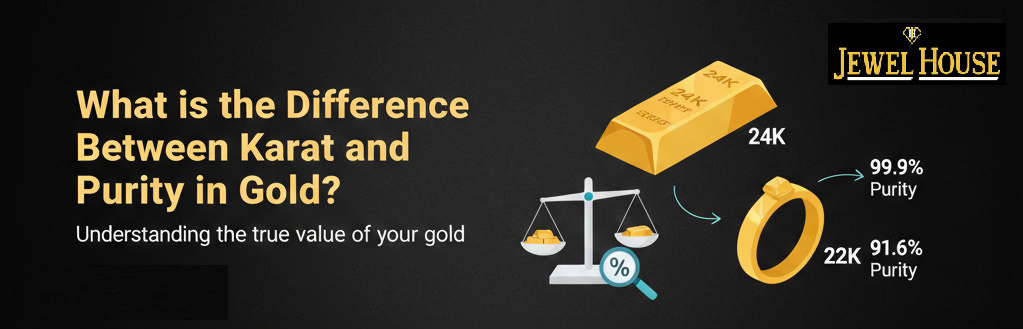
If you have ever tried to sell gold or simply wanted to understand the value of your jewellery, you may have come across two terms — karat and purity. While both describe the quality of gold, they are not the same thing. In simple terms, karat is a unit of measurement, whereas purity refers to the actual percentage of gold present in a piece. Understanding this difference helps you make better decisions when selling or evaluating your gold.
What Does Karat (K) Mean?
Karat is the standard unit used to measure the proportion of pure gold in a jewellery piece or gold item. It is expressed on a scale of 24, where 24 karat represents the purest form of gold available.
In India, most gold jewellery is made in 22K or 18K, because pure 24K gold is too soft for everyday wear and for intricate design work. The karat marking you see stamped on your jewellery — such as “22K” or “750” — tells you how much of the piece is actual gold and how much is alloyed metal like copper or silver. Think of it this way: 24 parts out of 24 are gold in 24K, while only 22 parts out of 24 are gold in 22K jewellery.
What Does Gold Purity % Mean?
Gold purity is the percentage equivalent of the karat value. It tells you how much gold (by weight) is present in a given item. This is especially important when you want to sell your gold and need to know the exact worth of what you are holding.
For instance, if your gold chain is 22K, it means it contains 91.6% pure gold — the remaining 8.4% comprises other metals used to strengthen the piece. When gold buyers or testing labs evaluate your jewellery, they use purity percentages to calculate its value based on current gold rates in Mohali.
24K vs 22K vs 18K — Comparison Table
| Karat | Purity % | Common Use |
| 24K | 99.9% | Gold coins, bars, and bullion |
| 22K | 91.6% | Traditional jewellery, bangles, necklaces |
| 18K | 75.0% | Designer and studded jewellery |
This table is helpful when you want to know the difference between karat and purity in gold at a glance. The higher the karat, the higher the purity — and consequently, the higher the value per gram.
Why Karat Matters When Selling Gold?


When you decide to sell gold, the karat of your gold directly determines how much cash on gold you will receive. A reputable gold buyer will always test your gold’s purity before making an offer. The price is calculated based on the item’s purity percentage, weight, and the current market rate.
For example, if the market rate for 24K gold is ₹7,000 per gram, then 22K gold (at 91.6% purity) will fetch you approximately ₹6,412 per gram. This is why it is critical to understand the karat of your jewellery before approaching any gold buyer.
Knowing how gold is weighed and tested — including the use of tools such as XRF machines and touchstone testing — helps you stay informed throughout the process. To learn more, visit our detailed guide on how gold is weighed and tested at Jewel House.
Conclusion
Understanding the difference between karat and purity in gold is essential before you sell old gold jewellery. Karat tells you the proportion of gold in the piece, while purity % gives you the exact gold content by weight. Whether your jewellery is 24K, 22K, or 18K, knowing what these numbers mean ensures you receive an equitable, clear price.
Visit Jewel House Chandigarh for accurate purity testing and get the best value for your gold — with complete transparency, on-the-spot evaluation, and instant cash. We are located at S.C.O – 7, Sector 19-cD, Chandigarh. Call us at +91-9815150400 to know more.


