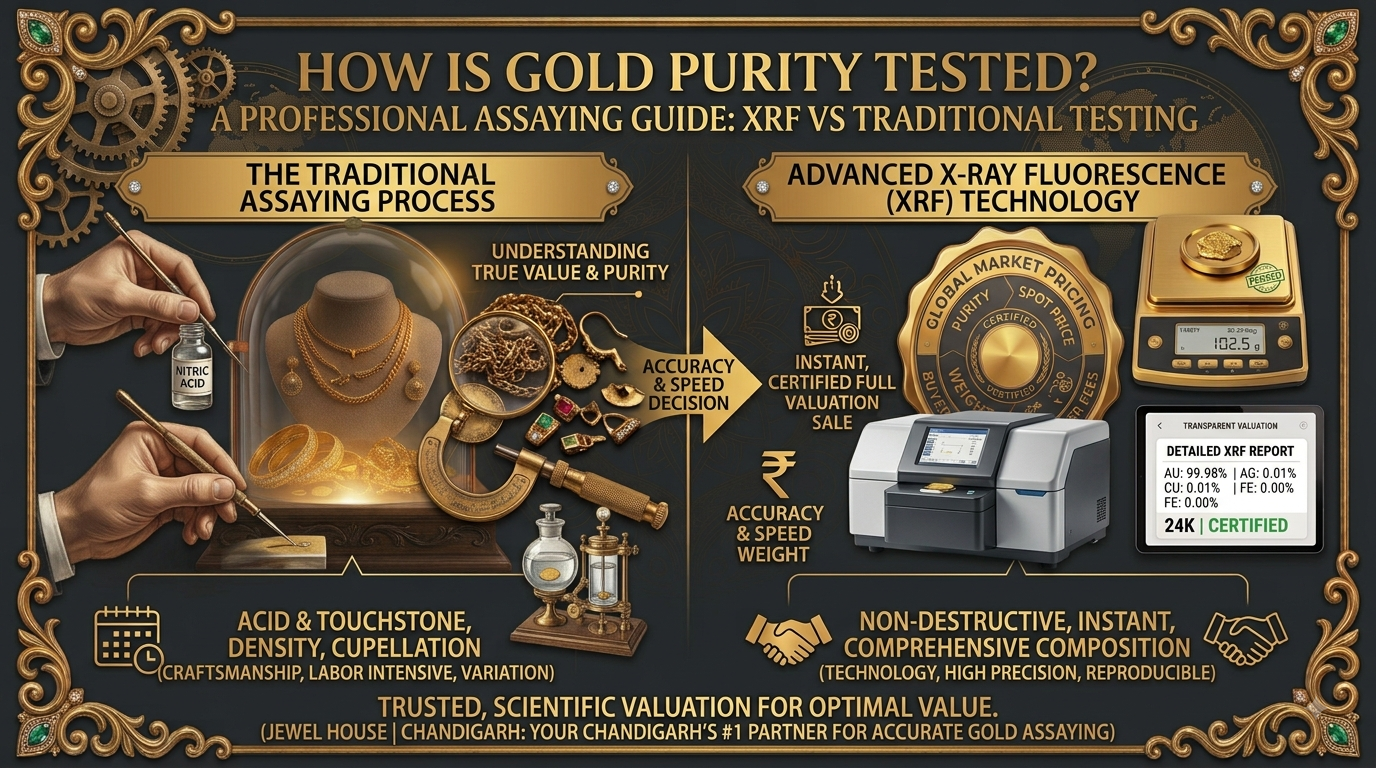
If you place two gold chains side by side, they will look the same, yet one’s worth double the other. Weird, right? The difference is purity, and you can’t see it. Not even a seasoned jeweller can eyeball it. That’s the reason gold purity testing exists. Buying, selling, or just wondering what grandma’s bangles are made of, someone has to measure the gold inside. There are two ways to do it: the old-school acid and fire tricks people have used for ages and the XRF machine that reads gold in seconds without laying a finger on it. Let’s break down both.
What Does “Gold Purity” Mean?
Pure gold is 24K, meaning 99.9% gold, or “999” fineness. The trouble is, pure gold is soft, bend-it-with-your-fingers soft. So jewellers mix in copper and silver to toughen it up, and that mix is what karat measures. So 22K gold is 91.6% pure (that “916” stamp you’ve seen), 18K is 75% (“750”), and 14K lands around 58.3%.
Whenever someone runs a gold purity check, a 22K or 24K gold purity test, they’re answering one thing. How much of this is real gold, and how much is filler?
Traditional Gold Testing: The Classic Methods
Long before any machine existed, people cracked gold’s authenticity with chemistry and heat. Two methods stuck around because, honestly, they work.
1. Touchstone & Acid Test
You’ve probably watched this at a jeweller’s counter. They rub your gold on a rough black stone, a basalt touchstone, which leaves a little metal streak, like a crayon mark. Then they drip acid on it: nitric acid for regular gold, and aqua regia (a nitric plus hydrochloric mix) for high-karat pieces, since pure gold shrugs off plain nitric acid.
Now they watch. Real, high-karat gold barely flinches. Fake or low-karat metal fizzes, dulls, or changes colour fast. The quicker and stronger that reaction, the less gold is in there.
It’s cheap, quick, and portable. The tester reads the reaction by experience, you only get a rough karat, it leaves a tiny scratch, and someone’s handling dangerous acids. (Some jewellers use small electronic pen testers too, but those only give a ballpark.)
2. Fire Assay
Fire assay is the most accurate gold purity testing method there is, and refineries and mints treat it as the final word. A small piece gets snipped off, wrapped in lead, and melted in a furnace hotter than 1000°C. The lead soaks up the junk metals and burns off, leaving a clean gold-silver bead.
That bead is treated with acid to strip out the silver, then weighed. The result is 99.9% or higher. It destroys your gold and takes hours in a lab. It’s perfect for a gold bar but useless for your wedding ring.
XRF Gold Testing: How the Machine Reads Your Gold
It is the modern way. XRF is short for X-ray fluorescence, the tech inside this gold testing machine makes buyers wave it over your jewellery. You hold your gold to the machine’s window: no scratching, no cutting, and no acid. The machine fires harmless X-rays at it, and those rays “excite” the atoms in the metal.
Every kind of atom, gold, silver, copper, nickel, fires back its own signature X-ray, basically a fingerprint. A sensor reads all those fingerprints at once, and the software instantly shows what’s inside, down to 0.01%, in seconds.
And no, it won’t hurt anything. Can XRF testing damage gold? Not a chance. Nothing touches it, nothing melts, and the rays leave zero mark. That’s why XRF has become the standard for how jewellery gold purity is checked before any money moves.
XRF vs Traditional Gold Testing: The Real Comparison
| Factor | XRF Gold Testing | Traditional (Acid / Fire) |
| Damage | None, nothing touched | Scratches or destroys it |
| Speed | A few seconds | Minutes to hours |
| Accuracy | Very high (~0.01%) | Rough (acid) / exact (fire) |
| Safety | No chemicals, no heat | Strong acids, high heat |
| Best for | Jewellery, coins, scrap | Refineries, quick checks |
One thing XRF can’t do, though: it only reads the surface, a few microns deep. So a gold-plated piece, or a bar stuffed with tungsten, can slip past it. That’s why gold buyers never trust XRF alone on bars, they also check weight and density (specific gravity) to catch fakes.
How Do Gold Buyers Test Gold and What Should You Trust?
Truth is, most pros mix and match. For everyday jewellery, XRF wins hands down: quick, safe, accurate, no damage. Fire assay stays the boss for big lots, and the acid test sticks around as a handy backup.
And if you’re wondering how to test gold purity before selling, the secret isn’t the method, it’s the person. Pick a buyer who tests your gold right in front of you, nothing hidden.
The Bottom Line: Where to Sell My Gold
That “in front of you” is where Jewel House shines. They’ve been doing it for over 30 years at S.C.O. 7, Sector 19-D, Chandigarh, giving instant Cash for Gold near you with live purity testing and weighing done right before your eyes. You get the best market rate, you can release pledged gold stuck with banks or pawnbrokers, and you’re out with cash in roughly 10 minutes, fully transparent. Do you want a direct answer first? Ask for Mr Deepinder Singh.
FAQs
- What’s the most accurate way to test gold purity?
Ans: Fire assay has 99.9%+ accuracy, but it destroys the piece. For jewellery, XRF gives near-lab accuracy with no damage. - How does XRF test gold purity?
Ans: It fires X-rays at your gold, reads the unique signal each metal sends back, and shows the exact makeup in seconds. - Can XRF testing damage gold?
Ans: Nope. It’s totally non-destructive, no scratch, no heat, no mark left. - How do gold buyers test gold before paying?
Ans: Usually XRF for a quick, accurate read, sometimes backed by an acid test or weighing. Always watch them do it. - What’s the difference between 22K and 24K gold?
Ans: 24K is 99.9% pure; 22K is about 91.6% (“916”) and harder, so it holds up better for daily wear. - How do I check gold purity before selling?
Ans: Check the hallmark stamp, then get an XRF test from a buyer who weighs and tests in front of you.


