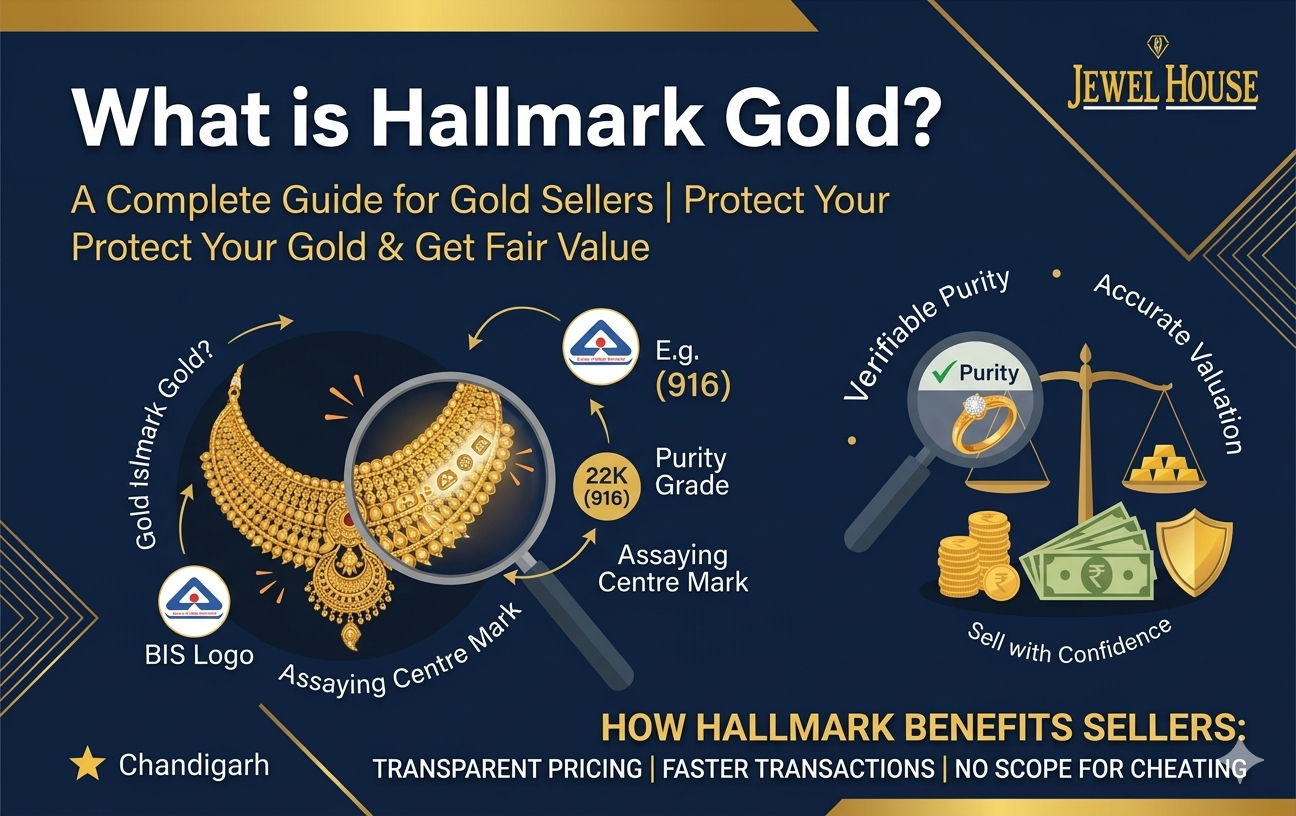
If you have ever wondered what is hallmark gold, you are not alone. Many people in Tricity who own gold jewellery are unsure what the small stamps on their pieces actually mean or whether those markings affect their payout when they decide to sell. This is a genuinely important question because understanding hallmark gold can help you make better decisions at every stage. Whether you are buying, holding, or preparing to sell your jewellery.
What is BIS Hallmark?
BIS stands for Bureau of Indian Standards — the national body responsible for certifying the purity of gold in India. A BIS hallmark is an official mark applied to gold jewellery only after it has been tested and certified by a BIS-recognised Assaying and Hallmarking Centre.
The BIS Hallmarking scheme was introduced to protect Indian consumers from being sold gold of inferior purity. Before it was enforced, jewellery was routinely sold at a stated karat without independent verification. The hallmark addressed this by introducing a standardised, government-backed certification system.
Since June 2021, BIS hallmarking has been made mandatory for gold jewellery sold by licensed jewellers across India.
What Does the Hallmark Stamp Include?
A BIS hallmark stamp on gold jewellery typically contains three key elements. Understanding each one helps you read your jewellery’s certification at a glance.
- BIS Logo — The triangular mark of the Bureau of Indian Standards. Its presence confirms that the jewellery has been officially submitted for testing and cleared by an authorised centre.
- Purity Mark — This is expressed as a three-digit number indicating the fineness of the gold. Common purity marks include:
- 999 — 24 Karat gold (99.9% pure)
- 916 — 22 Karat gold (91.6% pure), the most common grade for jewellery in India
- 875 — 21 Karat gold (87.5% pure)
- 750 — 18 Karat gold (75% pure)
- 585 — 14 Karat gold (58.5% pure)
- Assaying Centre Mark — A unique alphanumeric code that identifies the specific BIS-recognised Assaying and Hallmarking Centre where the jewellery was tested. This creates a traceable record of where and when the certification took place.
Together, these three elements confirm that the gold has been independently verified and meets India’s established quality standards, giving both the buyer and the seller confidence in the stated purity.
Why Hallmark Matters When Selling Gold?
When you bring gold jewellery to a buyer, the hallmark offers a useful starting reference. A 916 stamp, for example, immediately signals that the piece is 22 Karat and should be priced accordingly. This can speed up the initial assessment and set clear expectations on both sides.
However, it is important to understand that a hallmark stamp alone does not determine your final payout. Reputable gold buyers in Mohali always conduct their own independent purity test using calibrated equipment — regardless of what the stamp says:
- Jewellery can be repaired or altered after hallmarking, changing its actual gold content.
- Stones or lower-purity additions used in repairs can affect the purity reading.
- A buyer has a professional responsibility to verify what they are paying for.
So while the hallmark is a helpful indicator, the in-house purity test remains the definitive step. It is always worth checking the current gold rate in Chandigarh before your visit so you have a clear benchmark.
How to Read Your Gold’s Hallmark Before Visiting a Buyer
Before bringing your jewellery in for a valuation, inspect it under good light or a magnifying glass. Look for the BIS logo and the purity number on an inner surface, clasp, or flat section of the piece. Noting the karat mark lets you ask informed questions during the testing process and gives you a reasonable expectation of the offer you will receive.
If the stamp is worn, unclear, or absent altogether, do not worry. Non-hallmark gold is tested using physical methods that do not rely on the stamp. Read more in our guide on Selling Non-Hallmark Gold in Chandigarh.
Is Hallmark Compulsory to Sell Gold?
No. While BIS hallmarking is mandatory for jewellers selling new gold jewellery, it is not required for individuals selling their existing pieces. Whether your jewellery carries a clear hallmark, a faded one, or none at all, you can still sell it. The purity will be assessed through physical testing at the buyer’s premises.
Conclusion
Understanding what hallmark gold is puts you in a far stronger position as a seller. The BIS hallmark certifies your jewellery’s purity at the time it was made — but the final valuation always depends on an accurate, independent purity test conducted at the time of sale.
Whether your gold is hallmarked or not, what matters most is choosing a trusted buyer who tests transparently and pays at the live market rate. To understand the full process before your visit, learn more about how the gold-selling process works at Jewel House.
Frequently Asked Questions
Q1. What is Hallmark Gold in simple terms?
Hallmark gold is jewellery that has been officially tested and certified for purity by a BIS-recognised centre in India.
Q2. What does 916 mean on a gold hallmark?
916 indicates 22 Karat gold — the jewellery contains 91.6% pure gold by weight.
Q3. Is BIS hallmarking mandatory in India?
Yes, since 2021, BIS hallmarking is mandatory for gold jewellery sold by licensed jewellers across India.
Q4. Can I sell Hallmark gold without the original bill?
Yes. Hallmark gold can be sold with valid KYC documents even without the original purchase bill.
Q5. Does Hallmark gold fetch a better price than non-Hallmark gold?
Not necessarily. Final price depends on the tested purity and weight, not just the stamp.
Q6. What are the common BIS purity marks?
The common marks are 999 (24K), 916 (22K), 875 (21K), 750 (18K), and 585 (14K).


